Multi-agent systems · GenAI platforms · Federal AI

Chris Cordaro

Full-stack AI Engineer

I build production AI: autonomous agentic workflows, RAG pipelines, and full-stack GenAI platforms, from schema to ship.

Chris Cordaro
10+
Years Building
3
Production AI SaaS
14
Agent Personas
$300M+
Federal Funding Coordinated

$ whoami

Full-stack AI Engineer · founder

Raleigh, NC

$ cat focus.txt

multi-agent systems & orchestration

RAG & hybrid retrieval

full-stack GenAI, schema to ship

federal AI · FedRAMP · CMMC

Engineer, founder, operator.

I’m a full-stack AI engineer, program manager, and technical founder with 10+ years building enterprise data systems, generative-AI platforms, and autonomous agentic workflows for federal and defense clients.

As the sole architect of three production SaaS products, I’ve designed multi-agent orchestration systems with autonomous task planning, tool-use coordination, and persistent memory for long-running federal workflows, and shipped them end-to-end, from database schema to deployment.

That engineering depth is paired with hands-on program management of teams up to 16, coordination of $300M+ in federal funding, and deep domain expertise across FAR/DFARS, FedRAMP, CMMC, and the Shipley methodology.

  • Autonomous multi-agent systems & orchestration
  • RAG pipelines and hybrid retrieval
  • Full-stack GenAI products, schema to ship
  • Federal & defense domain (FAR/DFARS, FedRAMP, CMMC)

Production AI, shipped.

Platforms I designed and built end-to-end: autonomous agents, retrieval systems, and full-stack products serving federal and enterprise users.

Full-stack opportunity intelligence

Federal Solicitation-Monitoring SaaS

A from-scratch SaaS that aggregates federal opportunities from multiple sources, scores them with an AI composite model, and deduplicates across four levels of source overlap.

PythonFastAPIPostgreSQLpgvectorDockerCloudflare Zero Trust

Composite scoring plus four-tier dedup over a continuously refreshed federal opportunity feed.

. Expands with artifact, narrative, and demo link.
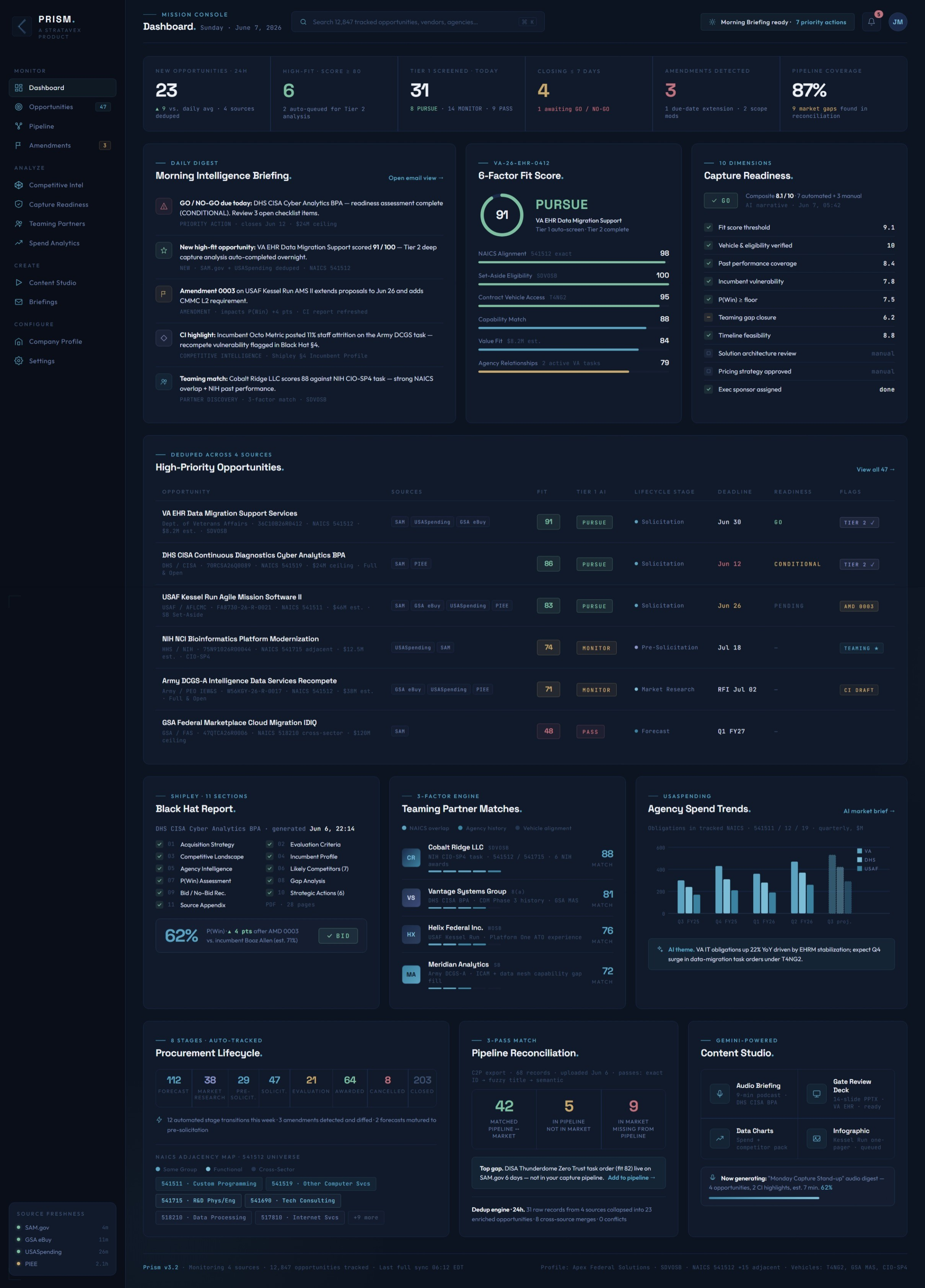
Solicitation-monitoring dashboard showing scored opportunities and source dedup status
Opportunity feed with composite scores and source dedup status

I built SCOUT alone, end-to-end: ingestion adapters that pull each federal source on its own refresh cycle, a composite score that blends structured signals with pgvector embedding similarity, and the piece that took longest to get right, deduplication. The same solicitation can surface in four places (primary, mirrored, syndicated, amended) with conflicting metadata, and the system has to elect a canonical record without losing the audit trail of its duplicates. It runs as a containerized FastAPI service on Postgres behind Cloudflare Zero Trust with no public ingress; workers handle refresh and scoring, and the API serves the scored feed to the front-end.

  • Composite score blends structured features with pgvector embedding similarity
  • Four-tier dedup across primary, mirrored, syndicated, and amended sources
  • Cloudflare Zero Trust gates the entire surface; no public ingress
Open the live SCOUT dashboard
Retrieval-augmented synthesis

RAG Copilot

A conversational copilot with intent classification and hybrid retrieval (full-text search + vector embeddings) that streams context-enriched LLM responses.

RAGHybrid RetrievalVector EmbeddingsStreaming LLMpgvector

Context-grounded answers across 50K+ federal solicitations.

. Expands with artifact, narrative, and demo link.
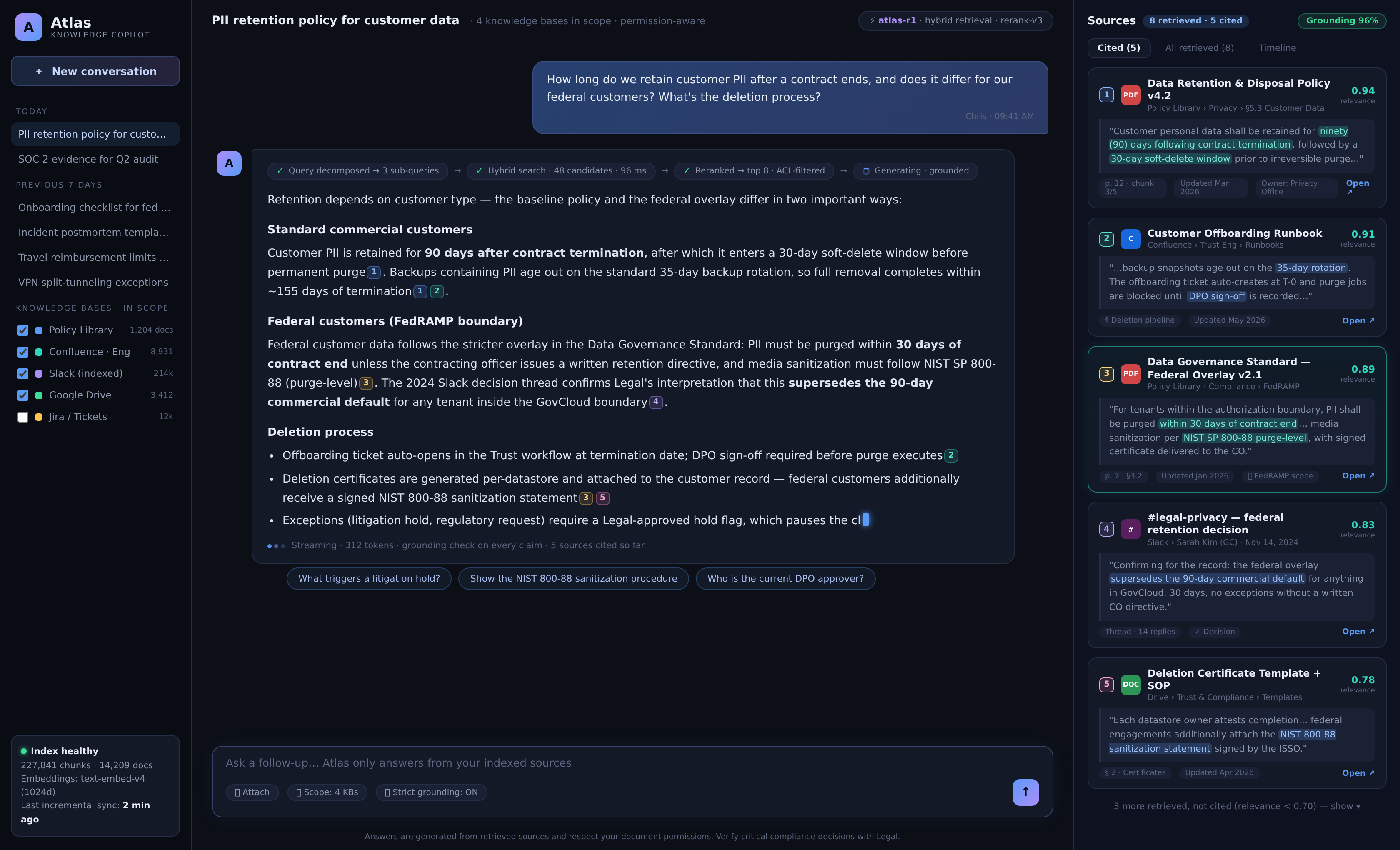
Conversational copilot streaming an answer with retrieved source citations alongside
Streamed answer with retrieved sources surfaced inline

Hybrid retrieval was the lever. Dense-only and sparse-only indexes both lose precision on federal solicitation language, so Prism runs Postgres full-text search and pgvector cosine similarity in parallel, fuses the result sets, and reranks before the LLM ever sees context. I put an intent classifier upstream to decide whether a turn needs retrieval at all; most conversational follow-ups do not, which keeps cheap turns cheap and fast. Answers stream token-by-token with their retrieved sources surfaced alongside, so you can check a claim against its source while the answer is still assembling, not after it finishes.

  • Hybrid full-text + vector retrieval with rerank fusion
  • Intent classifier short-circuits retrieval for conversational follow-ups
  • Sources surfaced inline as the answer streams, not appended at the end
Open Prism on Stratavex
Autonomous 4-phase pipeline

Multi-Agent Competitive Intelligence

A multi-agent workflow with role-specialized agents (research, analysis, synthesis, review) and real-time SSE progress, integrating government data APIs.

Multi-AgentSSESAM.govUSASpendingFPDS

Four typed phases (research, analysis, synthesis, review) streamed live as SSE progress.

. Expands with artifact, narrative, and demo link.
SSE PROGRESS STREAM RESEARCH sam.gov · fpds ANALYSIS structure findings SYNTHESIS long-form output REVIEW verify · cite EACH PHASE EMITS TYPED EVENTS · READER WATCHES LIVE
Research · Analysis · Synthesis · Review · SSE progress streamed to the reader

Pulse splits a competitive-intelligence question into four typed phases that run as a directed graph: research agents fan out across SAM.gov, USASpending, FPDS, and SBA in parallel; analysis agents structure what comes back against the question; a synthesis agent writes the long-form report; and a review agent runs the consistency and citation pass before anything ships. Every phase emits SSE progress events you watch live, so a long-running report never feels like a black box. I gave each role only the tools it needs (research gets the data APIs, analysis gets structured extraction), which keeps every agent small and its prompt size predictable.

  • Four typed phases as a directed graph: research → analysis → synthesis → review
  • Per-phase tool access, so each agent stays small and focused
  • SSE progress streamed to the reader for visibility into long-running reports
Open Pulse on Stratavex
Command + build crews

14-Persona Agent Orchestration

A cognitive-architecture system of 14 autonomous agent personas, a 4-member command team and 10-member build crew, with persistent memory and cross-agent coordination protocols for parallel execution.

Agent PersonasPersistent MemoryOrchestrationTool Use

Fourteen agents (4 command, 10 build) coordinating via content-addressed shared memory.

. Expands with artifact, narrative, and demo link.
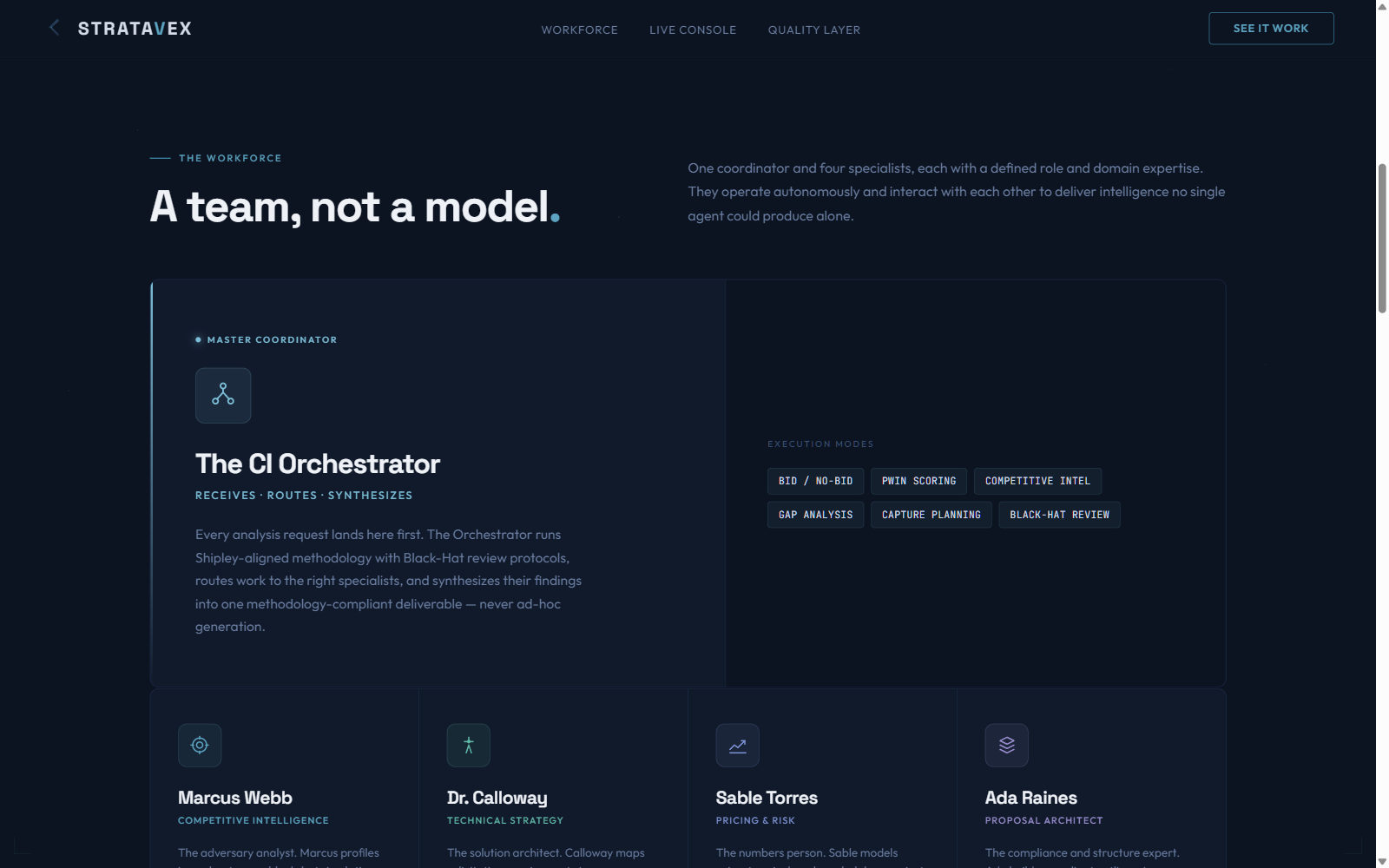
Multi-Agent Workforce: The CI Orchestrator card alongside four specialist agents (Marcus Webb, Dr. Calloway, Sable Torres, Ada Raines) with their roles and execution modes
The CI Orchestrator routes work to four specialist agents · interactive demo via the link

I modeled this as an organization, not a swarm: a four-member command tier sets direction and resolves contention, and a ten-member build crew executes against the tickets command issues. Each persona carries its own system prompt, tool set, and persistent memory file, so an agent that worked an earlier ticket can be re-summoned and pick up where it left off. Coordination is the part most multi-agent systems get wrong. Shared memory here uses content-addressed writes, so two agents working in parallel cannot silently overwrite each other, and the command tier arbitrates when two build agents claim overlapping work.

  • Four-member command tier, ten-member build crew, fixed responsibilities per role
  • Persistent per-persona memory survives across sessions and re-summons
  • Content-addressed shared memory prevents silent overwrite under parallel execution
Open the live workforce demo
Interoperable agent skills

10 Cross-Platform AI Agent Products

Production AI agent products packaged as LLM skills, MCP servers, and plugins, installable with zero runtime dependencies across Claude Code, Gemini CLI, and ChatGPT CLI.

MCPLLM SkillsPluginsClaude CodeGemini CLI

One source compiles to skill, MCP server, and plugin shapes across three host CLIs.

. Expands with artifact, narrative, and demo link.
10 AGENT PRODUCTS × 3 HOST PLATFORMS CLAUDE CODEGEMINI CLICHATGPT CLI COMPLIANCE MATRIX RFI RESPONSE INCUMBENT BRIEF IGCE BUILDER RED TEAM CHECKER PP LIBRARY PLUGIN TEAMING MCP FORECAST AGENT PRICE-TO-WIN AGENT COLOR TEAM AGENT ONE SOURCE · THREE SHAPES · ZERO RUNTIME DEPENDENCIES
Ten agent products · three host platforms · one packaging contract

The interesting decision was packaging. Each product compiles from one source into three shapes: an LLM skill bundle (Markdown plus frontmatter, no runtime), an MCP server (tool definitions plus transport), and a plugin for the three host CLIs. The packaging contract is the load-bearing piece: a single manifest describes capabilities once, and a build step emits the platform-specific artifacts. Zero runtime dependencies means installing is a file copy, not a package-manager dance, and that matters because the audience is engineers who want to try a tool in 30 seconds and decide.

  • One source compiles to skill, MCP server, and plugin shapes
  • Zero runtime dependencies; install is a file copy
  • Same agent works identically across Claude Code, Gemini CLI, and ChatGPT CLI
Browse the source on GitHub
Public oversight dashboards

UkraineOversight.gov

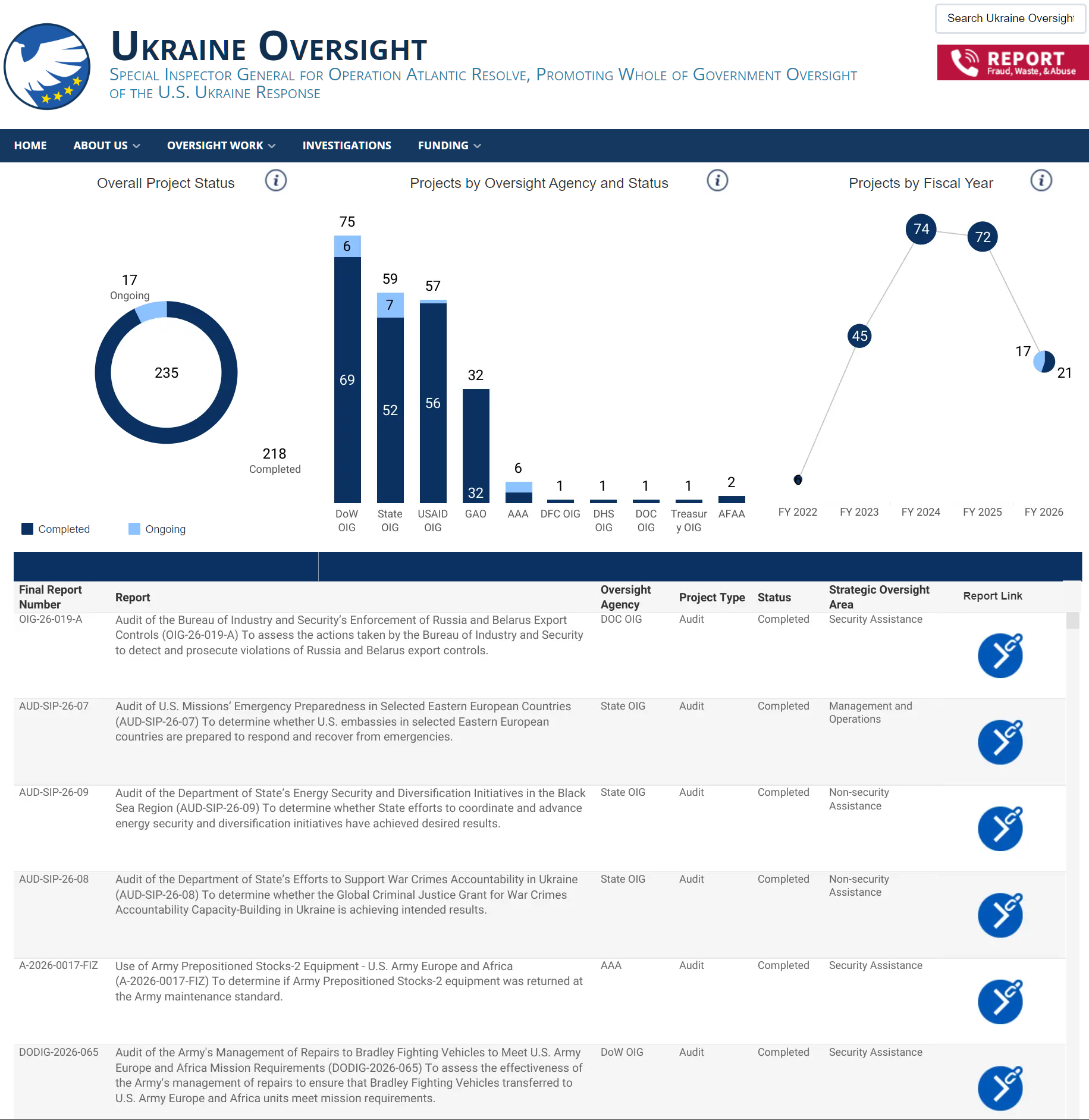
Public-facing interactive Tableau dashboards for oversight of federal Ukraine-related funding, designed and delivered end-to-end for the DoD Inspector General.

TableauData EngineeringPublic SectorBI

Recognized by CNN, C-SPAN, and Congress; Glenn/Roth Award for Exemplary Service.

. Expands with artifact, narrative, and demo link.
UkraineOversight.gov dashboard showing federal Ukraine-related funding flows by agency and program
Live dashboards · deployed at ukraineoversight.gov

I was the sole BI engineer on this, working directly with the DoD Inspector General team. The dashboards trace federal Ukraine-related funding across agencies, programs, and execution channels, with drill-downs that let a Congressional staffer or an oversight reporter answer "what was appropriated, what was obligated, and where did it end up" without writing SQL. The data engineering underneath stitches together appropriations, obligations, and disbursements from sources that do not naturally join; the reconciliation logic was the real work, not the visuals.

  • Sole BI engineer; designed schema, ETL, and the user-facing dashboards
  • Reconciliation logic across appropriation, obligation, and disbursement sources
  • Glenn/Roth Award for Exemplary Service; coverage in CNN, C-SPAN, and Congress
Open the live dashboards

A decade of building.

From founding AI products to leading federal modernization programs and teams of 16.

Now

Founder & Technical Lead

Stratavex

Oct 2025 – Present Raleigh, NC

Sole architect, engineer, and operator of three production AI platforms for the government-contracting market.

  • Built a full-stack solicitation-monitoring SaaS from scratch — Python/FastAPI, PostgreSQL + pgvector, Docker, Cloudflare Zero Trust — with AI composite scoring, 4-level source dedup, and multi-source opportunity aggregation.
  • Shipped a RAG copilot with intent classification, hybrid retrieval (full-text + vector), and streaming LLM synthesis across 50K+ federal solicitations.
  • Architected a multi-agent competitive-intelligence pipeline: a 4-phase autonomous workflow with role-specialized agents and live SSE progress, integrating SAM.gov, USASpending, FPDS, and SBA.
  • Designed 14 autonomous agent personas (a 4-member command team + 10-member build crew) with persistent memory and cross-agent coordination protocols.

Senior Associate — Program Manager

Knowesis Inc.

Oct 2025 – Present Raleigh, NC

Leads a 16-person team on the Health Readiness Policy & Oversight contract across the Military Health System.

  • Spearheaded the MEDLOG pharmaceutical supply-chain illumination initiative — a dual-track AI-augmented evaluation framework — and authored executive communications recommending an OTA-funded pilot to ASD(HA).
  • Replaced a manual monthly burn-reporting process with a Python pipeline producing 15 status reports, labor-hour variance workbooks, and AI-assisted run-out projections from one accounting input.
  • Leads capture planning and Shipley-method proposal development: L/M/C/H analysis, color-team reviews, and compliance-matrix mapping for DoD and civilian pursuits.

Enterprise Business Innovation Manager

Department of Defense, Office of Inspector General

Aug 2024 – Sep 2025 Alexandria, VA

Led agency-wide, data-driven transformation, aligning analytics strategy with mission priorities and securing senior-leadership buy-in.

  • Directed AI and predictive-analytics solutions for workforce planning — cutting time-to-hire by 10% and manual analysis time by 60%.
  • Ran an Agile delivery program with Requirements Traceability Matrices linking technical deliverables to mission outcomes.
  • Drove change management that moved teams from manual reporting to self-service analytics.

Program Manager / Technical Lead

Knowesis Inc. — DoD Inspector General

Sep 2019 – Aug 2024 Alexandria, VA

Directed a 15+ person team of data scientists, engineers, and BI analysts delivering enterprise analytics and modernization for the DoD IG.

  • Led design and development of UkraineOversight.gov — public interactive Tableau dashboards recognized by CNN, C-SPAN, and Congress.
  • Won the Glenn/Roth Award for Exemplary Service; achieved 98% on-time delivery across all deliverables.
  • Drove a modern-data-stack migration over 40+ sprints (35% cost/scalability gain) and built a self-service platform for 400+ users.
  • Founded a Data Science Center of Excellence for methodology, governance, and mentorship.
View earlier roles 2 positions · 2013 – 2019

Solution Architect / Technical Lead

Knowesis Inc. — FEMA / Defense Health Agency

Feb 2018 – Aug 2019 Washington, DC

Architected cross-platform federal systems on AWS during active disaster events and enterprise records modernization.

  • Delivered a cross-platform disaster-recovery system (iOS, Android, web) on AWS with Power BI, GIS, and REST APIs across 6 rapid sprints — primary technical contact under 4-hour response SLAs.
  • Built an enterprise records-management system with automated content classification, NLP, and BI dashboards — cutting manual workload 45% with 94% on-time delivery.

Data Manager

Atkins (SNC-Lavalin) — FEMA

Sep 2013 – Feb 2018 Columbia, SC

Built enterprise data solutions supporting FEMA funding coordination across $300M+ and 22 counties.

  • Implemented data validation and analytics frameworks achieving a 0.05% error rate.

Technical stack.

AI & GenAI

LLM architecture designMulti-agent orchestrationAutonomous agentic workflowsRAG pipelinesHybrid retrievalPrompt engineeringClaude APIGemini APIMCP / Model Context ProtocolLangChain / LangGraphAgent persona designPersistent memory systems

Languages & Frameworks

PythonTypeScriptJavaScriptSQLReactNext.jsFastAPINode.jsRVBA

Machine Learning

TensorFlowscikit-learnXGBoostBERTLSTMNLPPredictive analyticsML lifecycle

Cloud & Infrastructure

DockerKubernetesVercelCloudflare (Tunnel, Zero Trust, Workers, R2)AWS (S3, Lambda)AzureGCP

Databases

PostgreSQLpgvectorSQLAlchemyDrizzle ORMNeon ServerlessAlembicSQL ServerOracle EBS

Frontend

HTMXAlpine.jsTailwind CSSJinja2shadcn/uiMDXReact EmailMulti-theme systems

DevOps & Testing

Git · GitHub Actions · pytest · Vitest · Ruff · mypy · Semgrep · CI/CD

BI & Analytics

Tableau (Cloud + Desktop) · Power BI · QlikView

Federal Domain

FAR / DFARS · FedRAMP · CMMC · SAM.gov · Shipley methodology · Color-team reviews · Compliance matrices · NAICS / PSC

Certifications

  • PMI Agile Certified Practitioner (PMI-ACP) — 2022
  • Tableau Certified Associate — 2019
  • Data Science Professional Certificate, HarvardX — 2021
  • DataWalk Technical Professional — 2022

Let’s build something.

Open to AI engineering roles. The fastest way to reach me is email. Résumé below.

chriscordaro@gmail.com